
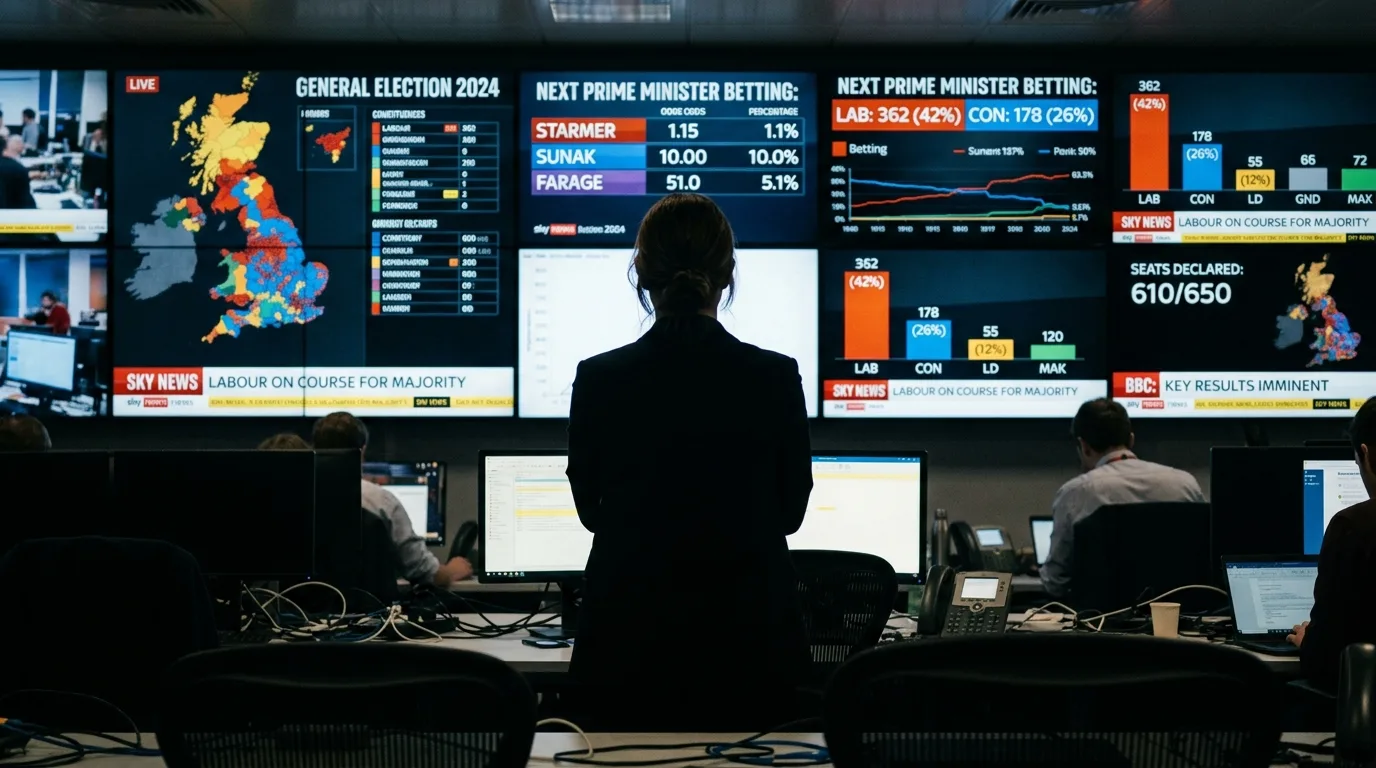
What prediction markets are
Prediction markets are platforms on which users place bets on the occurrence of future events. The spectrum ranges from political events such as elections or geopolitical escalations through sports outcomes to very specific questions such as the outdoor temperature on a given day or the number of tornado reports in a given month. The traded instruments are typically yes-no contracts. The price of a contract reflects the probability of occurrence as estimated by the market. If the event occurs, the holder of a yes contract receives one dollar per contract. If it does not occur, the stake is lost.
The two market-leading platforms are Kalshi and Polymarket. Kalshi holds the dominant share of the US prediction-market space and is licensed as a futures platform under the supervision of the Commodity Futures Trading Commission. Polymarket operates primarily in crypto tokens and is blocked in the United States for US persons. Growth figures are remarkable. Industry sources cite annual betting volumes in the double-digit billion range and monthly increases in the single-digit percentage range.
Gambling or financial instrument
The operators argue that they do not offer gambling. Kalshi treats its contracts as forward contracts to hedge uncertainties, comparable to traditional futures on commodities or currencies. Furthermore, on this reading users do not play against the house but against each other. The platform retains only a fee per contract.
From an Austrian perspective this argument is not consistently tenable. The Austrian Gambling Act ties the concept of gambling to the requirement that the decision over the outcome of the game depends exclusively or primarily on chance. For a range of typical prediction-market bets this is exactly the case. Anyone betting on the outdoor temperature on a particular day or on the number of tornadoes in a month will, as a rule, have no knowledge advantage that pushes chance into the background. In a societal wager in the legal sense skill and knowledge play a substantial role, so that participants can gain an advantage. This requirement is not met for many prediction-market bets.
Market reality adds to the picture. According to statements from the platform environment, 80 to 90 percent of all contracts on Kalshi are sports bets. In Austria sports betting is not governed by the Gambling Act but by the betting laws of the federal states. For pure sports-betting losses, recovery follows a separate line of argument based on partial incapacity to contract at the time of the bets (§ 865 of the Austrian Civil Code, ABGB), regularly evidenced by a medical expert opinion.
The Austrian assessment
Neither Kalshi nor Polymarket holds an Austrian concession under the Gambling Act or a betting licence under a state betting act. Contracts with players resident in Austria therefore arise whose civil-law validity is questionable under the settled case law of the Austrian Supreme Court. The line developed by the Supreme Court in OGH 6 Ob 31/24p and in a series of further decisions on the recovery of casino losses can, in our assessment, also be applied to bets with predominantly chance-based outcomes. Players in Austria who have placed stakes on a platform without the required concession can have a possible recovery under the rules of unjust enrichment examined. Prospects of success are assessed in the individual case; a Supreme Court decision specifically on prediction markets has not yet been issued.
For pure sports bets a separate recovery line applies based on partial incapacity to contract under § 865 ABGB. The evidence is typically provided by a medical expert opinion. Because of the costs of expert opinion, multi-instance proceedings and cross-border enforcement, an action as a rule becomes economically viable only above a loss amount of around 50,000 euros. Further details on the casino-versus-betting boundary are contained in the FAQ cluster on sports betting.
Consequences for players in Austria
Participation in unlicensed gambling is not a criminal offence for private persons in Austria. The administrative penalty provisions of the Gambling Act are aimed primarily at operators and intermediaries, not at players. Anyone who has bet via Polymarket, Kalshi or a comparable platform on the outcome of an election, a sports event or a natural development therefore faces no criminal or administrative-penalty consequences from an Austrian perspective.
The civil-law side is to be assessed separately. Losses on a platform that does not hold an Austrian concession are not simply lost but in principle recoverable. Which platform can be approached under which conditions and to what extent depends on the specific contracting party, the country of seat and the evidence available. A claim against a company based in the United States, in Curaçao or in another third country is to be conducted under Austrian substantive law. Enforceability of a judgment then depends on the general rules on the recognition and enforcement of foreign decisions and is assessed in the individual case.
Addiction potential and youth protection
The low entry stakes and the gamified presentation generate substantial addiction potential. Current studies from the United States show that a significant share of young people already engages in gambling activities. The platforms do require an identity document at profile creation, but that is no guarantee against circumvention. The Austrian legislator is currently preparing a reform of the Gambling Act. Whether developments on prediction markets will already be addressed there is open.
What affected persons should do now
Anyone who has incurred losses on a prediction-market platform should secure the placed stakes and the corresponding payment movements. Account statements, wallet histories in the case of crypto bets, screenshots of the platform history and the General Terms and Conditions in force at the time of registration are relevant. On this basis an individual assessment is possible as to whether and to what extent recovery is commercially worthwhile. The firm assesses mandates on a case-by-case basis and, on request, arranges contact with litigation funders so that you do not have to handle financing yourself.
Further questions
General questions on concession, procedure and limitation periods are addressed in the FAQ and on the recovery page. The FAQ area contains a dedicated cluster on sports betting for the distinction from casino claims.